Fertilizers

Plants require thirteen essential chemical nutrients, without which they will not survive, grow, or reproduce. These essential nutrients are broken down into three categories, based on plant usage.

These nutrients are required in large amounts by plants:

  • NNitrogen
  • PPhosphorus
  • KPotassium

These nutrients are required in lesser amounts by plants.

  • S    – Sulfur
  • Ca  – Calcium
  • Mg – Magnesium

These nutrients are required by plants in trace amounts:

  • Zn  – Zinc
  • Fe  – Iron
  • Cu  – Copper
  • Mn – Manganese
  • B     – Boron
  • Mo – Molybdenum
  • Cl   – Chlorine

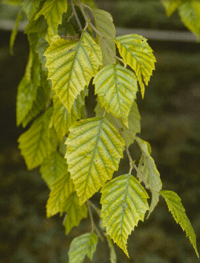
If these nutrients are not present in the soil in sufficient amounts your plants will not thrive and may even die. The most common deficiencies found are in the Primary Nutrients (nitrogen, phosphorus, and potassium), for these are in the greatest demand by plants and may be quickly depleted from garden soil. The acidic soil conditions in our area may also result in deficiencies in the Secondary Nutrients (sulfur, calcium, and magnesium). While the soil Micronutrient levels are usually adequate in Western Washington, deficiencies may be occasionally seen in boron and zinc.

Excess nutrient levels may also cause problems. For example, excess boron is toxic to plants, while excess nitrogen may cause excessive vegetative growth, delayed flowering, or fruiting, and may pollute ground water. Soil nutrient levels cannot be determined by inspection; you need to have your soil tested by a laboratory to determine its true nutrient content.

These nutrients must be in the correct chemical form for plants to utilize them. For example, nitrogen, which makes up approximately 70% of the atmosphere, must be converted by soil organisms into ammonium (NH4) or nitrate (NO3) before plants can utilize it.

water-drop-picIn addition, these essential nutrients are only available to plants if they are in a water-soluble form, for water transports the nutrients into the plant roots. Most of the essential nutrients found in the soil are not in a soluble form but are locked up within soil minerals and/or organic matter. Weathering of the soil minerals and the decomposition of organic matter releases these nutrients, but this process is quite slow.

If your soil’s available essential nutrient levels are low, or the nutrients present are not in the correct form, you can use fertilizers to quickly supply the essential nutrients your plants require.
Types of Fertilizers

Fertilizers supplement the soil’s nutrient supply, either providing essential nutrients that are lacking, or providing essential nutrients in the correct chemical form for plant uptake. In general, there are two types of fertilizers available (some fertilizers are a mix of these two types).

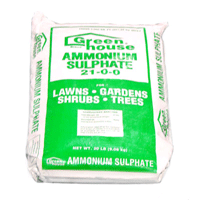
ammoniumsulfate.gifThese are fertilizers which have been manufactured or refined from natural ingredients. They tend to be concentrated and supply essential nutrients in a chemical form that is immediately available for plant use. The impact of these fertilizers is usually immediate, but short-lived. The exact chemical composition of these fertilizers is usually known.

Common synthetic fertilizers include ammonium sulfate, potassium chloride, monoammonium phosphate, and processed urea.

These are fertilizers that are in their natural form or have undergone minimal processing. These fertilizers are usually less concentrated than synthetic fertilizers, and often the nutrients they contain may need further breaking down in the soil before they are in a form available to plants. Although slower acting than synthetic fertilizers, the effects of organic fertilizers are longer-lasting. The chemical composition of these fertilizers may vary greatly, and the nutrient yield can only be estimated.

Common organic fertilizers include manure, cottonseed meal, cover crops, fish by-products, compost, raw minerals, and bone meal.

Most organic fertilizers, being natural products, contain a varying mixture of the essential nutrients. Synthetic fertilizers, which are carefully formulated, may contain only one, or several, of the essential nutrients.

Secondary Nutrients or Micronutrients may be added to your soil either as individual amendments (for example, powdered elemental sulfur), or as part of a fertilizer mix (these will be listed on the label).

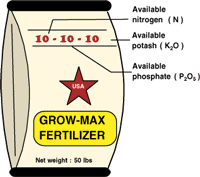
fertilizer-bag-picThe labels on fertilizer packages give the amount of the three Primary Nutrients (nitrogen, phosphorous, and potassium), expressed as a percentage of the total fertilizer weight. The format used to display this information is the “N-P-K” label, in which the first number is the percentage of nitrogen, the second number is the percentage of phosphorus (in the form of P2O5, or phosphate), and the third number is the percentage of potassium (in the form of K2O, or potash). For example:

N-P-K LabelNutrient Percentages by Total Fertilizer Weight
21-0-021% nitrogen, 0% phosphorus, 0% potassium
0-46-00% nitrogen, 46% phosphorus, 0% potassium
10-20-2010% nitrogen, 20% phosphorus, 20% potassium
8-8-88% nitrogen, 8% phosphorus, 8% potassium

As mentioned above, the N-P-K numbers on the label are the percentage by weight of the Primary Nutrients in the specific fertilizer. Therefore, a 100-pound bag of 10-20-20 fertilizer contains:

  • 10% N x 100 pounds = 10 pounds of nitrogen
  • 20% P x 100 pounds = 20 pounds of phosphorus
  • 20% K x 100 pounds = 20 pounds of potassium

The information presented by the N-P-K label is called the Fertilizer Analysis. For synthetic fertilizers, the Fertilizer Analysis is the guaranteed amount of nutrients available to plants. For organic fertilizers, the Fertilizer Analysis is the total amount of these nutrients, rather than the available nutrients. Because organic fertilizers release their nutrients slowly, the amount of nutrients immediately available for your plants is less than the organic Fertilizer Analysis.

Synthetic fertilizer recommendations are usually given in pounds of nutrient (for example, nitrogen) per a unit area (usually 100 or 1,000 square feet). You may also see fertilizer recommendations for a specific fertilizer mix (for example, 10-6-6) per area, or a dilution (for example, 1 cup fertilizer in 1 gallon of water) applied over an area.

Organic fertilizer recommendations can be more difficult, for the exact chemical composition of organic fertilizers may vary. For packaged organic fertilizers, follow the instructions on the label. For bulk organic fertilizers of unknown composition, such as compost or manure, you may need to experiment a bit with application rates and monitor your garden carefully.

Fertilizer rates vary, based on the application. The fertilizer label usually has rate recommendations for different applications. You may also contact your County Extension Office or the Master Gardeners for rate recommendations.

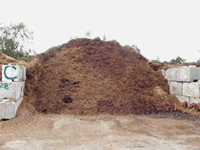
manure-pile-picAll types of manures (chicken, horse, beef, etc.) may harbor harmful pathogens which can contaminate vegetable crops, especially those grown in the soil. If these manures are not handled and stored properly or are used in the garden in either the wrong form or too soon before harvest, you may become seriously ill from contaminated produce. Your County Extension Office can assist you by providing the latest guidelines on the use of manures in the garden.

  • A Home Gardener’s Guide to Soils and Fertilizers
    WSU Extension Bulletin EM063E: From novice to advanced, all home gardeners should get to know their soil: the nuts and bolts of soil, and how to make it better.
  • Backyard Composting,
    WSU Extension Bulletin EB1784 explains the basic interactions of “fast” and “slow” composting, defines terms, and breaks raw composting matter into categories by moisture, porosity, and nitrogen content. Troubleshooting tips answer your questions and provide health and safety information. Learn how to build and turn a pile, what NOT to add, and how to use your finished compost.
  • Soil Fertility,
    WSU Extension Bulletin FS111E describes the benefits of cover crops, different types of cover crops and their suitability for different situations, and how to grow and manage cover crops in your garden.
  • Soils and Soil Testing,
    This website provides links for gardeners and farmers to resources on soil sampling, soil testing, and soil test interpretation.
  • Compost and Nutrient Management,
    This website discusses of the effects of compost applications on nitrogen availability and soil properties, current research, and provides useful links on composting.
Scroll to Top