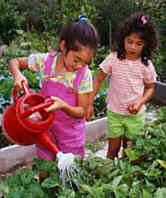
 A picture is worth a thousand words. Never tell kids something you could show them.
- Young kids have a very short attention span. Make sure that you have lots of options available so they can get started immediately and stay busy. Digging holes is one thing that seems to hold endless fascination.
- Instant gratification helps a lot. Plant radishes even if you don’t like them; they come up in three or four days.
- Growing their own will generally get kids to try eating things they otherwise wouldn’t walk into the same room with.
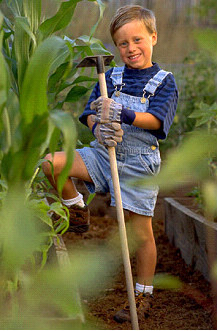
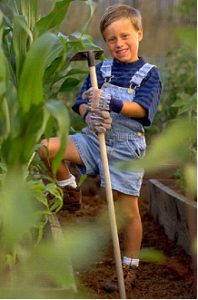 GETTING DIRTY IS AN INTEGRAL PART OF GROWING UP!
- Your role should be as facilitator, rather than as a leader who imposes direction. Be a good role model.
- When giving out supplies to several kids, try to keep seeds, tools, etc. as similar as possible to avoid the inevitable squabbles.
- After an activity, do something to reinforce what everyone has learned. Talk about what went on, who did what, who saw what. If you can, have them write things down or draw pictures. If they’re too young, take dictation.
- Many kids who won’t talk in a large group will often speak easily in a small group.
- When working with older kids (past about 13), one-to-one works better than groups, since gardening (and anything else that could get you dirty) is a remarkably un-cool and disgusting way to spend time. Try to add responsibility and ownership to projects. (“Quincy is in charge of the wheelbarrow today.”) Try pairing up older kids with younger ones. Rest assured that if you give them a healthy respect for gardens and green things when they are young, it will stay with them throughout their lives.
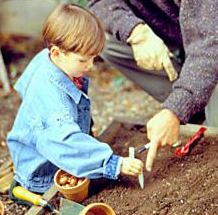
 4-H is more than just animal husbandry. In addition to Animal Sciences, 4-H offers programs and learning opportunities in Expressive Arts, Engineering and Technology, Family Living, Interdisciplinary, Environmental Stewardship, Plant Sciences, and Social Sciences. 4-H offers a wide variety of projects and activities, including workshops, conferences, camps, community service projects, and leadership development opportunities for both youth and adults at the local, district, state, national, and international levels.
Membership is open to youth in kindergarten through the 12th grade for most programs. Contact your local County Extension Office for more information on this superb youth organization.